
Two questions come up in almost every conversation with operators considering an autonomous club.
Will anyone go to an unstaffed facility?
Don't you lose the human touch?
They're the right questions to ask. They're the questions every owner-operator wrestles with before signing a lease, hiring a coach, or pouring concrete. And until recently, neither question had an answer with operating data behind it — only theory.
Pickleball 365, the first fully autonomous pickleball facility in Michigan, has now run on PodPlay for over a year. With Pickleball 365 preparing for the next phase of growth, owners Robert and Deanna Lorincz have agreed to share insights from their first year of operations. What follows is what the data says.
The short version: people show up at unstaffed facilities. They show up in volumes that staffed facilities can't match, because staffed facilities aren't open nearly as many hours. And the human touch — far from disappearing — gets concentrated where it actually compounds: in community-building, programming, and the kind of attention to detail that owner-operators are uniquely positioned to deliver when technology absorbs the operating load.
This is a case study about three courts in Fair Haven, Michigan. The lessons travel.

Pickleball 365 sits in Fair Haven, Michigan, about 40 miles north of Detroit. The facility opened in 2025 and runs 24 hours a day, 365 days a year. Three indoor courts, with a strong core membership base. Customers book on the PodPlay app, and the same app unlocks the door when they arrive. There is no front desk. There is no opening or closing time.
Utilization
Pickleball 365 measures utilization the only way that respects an autonomous business model: as a percentage of the full 24-hour day, every day of the year. Not "percentage of operating hours." Not "peak time only." The whole clock.
Over the trailing twelve months, utilization has been 46%. That works out to more than 11 court-hours booked per day, per court.
Over the most recent month, utilization was 57%. That's 13.7 court-hours booked per day, per court.
It's worth pausing on those numbers, because they tend to land harder when sat with.
A 24-hour day has 24 hours in it. A staffed pickleball club that opens at 8 AM and closes at 10 PM has 14 operating hours per day — the most a club can offer if it stays open every minute its doors are unlocked. Pickleball 365's three courts are now booking, on average, 13.7 hours of play per day. Pickleball 365 is selling more court-hours per day than many staffed clubs are open.
That is not a rhetorical flourish. It is the operating data.
Revenue per court
Revenue per court has grown meaningfully over the trailing twelve months, with the most recent month reflecting the strongest performance to date. The median pickleball club on PodPlay is generating approximately $8,000 per month per court. Pickleball 365 is handily above that benchmark, while operating in a small town market. The run-rate from the most recent month, applied across three courts, reflects a level of annual pickleball revenue that few three-court facilities in comparable markets achieve. These figures exclude sponsorships, ancillary revenue, and any non-pickleball revenue lines.
Revenue per hour used
Revenue per hour used strips out variation in how many hours the club is selling. Pickleball 365's revenue per hour used has held remarkably consistent over the past year and is inline with median rates for pickleball clubs across the PodPlay platform.
That figure is the result of a mix of offerings: reservations, memberships, peak-time premiums, and off-peak discounts. It includes coaching and programming — open plays, clinics, tournaments, and leagues. Strong revenue per court-hour, in a small Michigan market, with no on-site staff turning the lights on or off.
Operating costs
The operating cost structure is where autonomous economics announce themselves. The two largest fixed costs at Pickleball 365 are rent and PodPlay platform fees.
Rent reflects the Michigan exurban market. It is not a New York City number, a Miami number, or a Chicago number. Pickleball 365 is in a building Robert and Deanna would never have signed a lease on under a staffed model with full-time front-desk costs — but which has proven ideal for the autonomous model.
PodPlay covers booking, payments, member management, league and tournament management, video replays, digital scoreboards, autonomous door access, and 24/7 remote monitoring of the facility. It is a single line item on the P&L — technology replacing labor.
There is no full-time front desk. There is no opening-and-closing labor. There is no overnight security guard. The labor that exists at Pickleball 365 — coaches, occasional cleaning, customer-engagement work that Robert and Deanna do themselves — is concentrated where it generates revenue or builds community, not on the operating floor turning lights on and off.
Cost structure as strategy
JDC's published guide for a successful pickleball facility puts a benchmark on the table: rent and property costs — lease, triple nets, taxes, and CAM charges — at roughly 35% of revenue against the $1.2 million annual revenue mark JDC associates with successful scaled operations. That is the public benchmark, from the same firm that designed Pickleball 365.
Pickleball 365 is well inside that benchmark.
Total monthly operating costs at Pickleball 365 — including rent, technology, everything — are running meaningfully below JDC's published benchmark for property costs alone.
A facility past these benchmarks is not just sustainable. It has optionality — it can absorb a downturn, fund expansion, and support the kind of community investment Robert and Deanna are doing without taking it out of the owners' pockets.
The reason strong returns are achievable in Fair Haven is that autonomous economics work on both sides of the operating equation simultaneously. They expand the available revenue base. They compress the cost base. The two effects compound.
More hours
Available hours times utilization times revenue per hour equals revenue. That is the math any time-bound-inventory business — court rental, hotel rooms, restaurant tables, padel courts — runs on. Each variable is a lever.
A staffed pickleball club typically operates between 12 and 16 hours per day. Anything longer requires a labor stack — an opener, a closer, perhaps an overnight presence — that costs more than the marginal hours generate. So most staffed clubs land at 14 or so operating hours per day, with significant variation by market.
Pickleball 365 booked 13.7 court-hours per day in the most recent month. Pickleball 365 is selling roughly the same number of court-hours per day that many staffed clubs are even open. And it is doing so on three courts, with no opening or closing labor cost, and with available capacity remaining. Nearly half the day is untapped.
The available-hours expansion the autonomous model unlocks is not theoretical. Sharks Pool Club, which migrated from a staffed-lite operating model to PodPlay's autonomous infrastructure in 2023, expanded its operating hours from a 12-hours-per-day window (noon to midnight) to an 18-to-20-hour autonomous window (8 AM to 2 AM weekdays, 8 AM to 4 AM weekends). The Sharks case study, published on the PodPlay blog in February 2024, documents that the late-night hours — the ones staffed economics couldn't justify — turned into the highest-yielding utilization windows: late-night weekend utilization was regularly above 50%.
The same dynamic is visible at Pickleball 365. The additional hours when Fair Haven members can actually play — early mornings before work, late nights after the kids go to bed, the small hours when a shift worker is wrapping up — are the hours staffed economics rule out. Autonomous economics rule them in.
Lower costs
The cost-side compression is where the labor-substitution math gets concrete.
NAICS code 71394 — Fitness and Recreational Sports Centers — is the U.S. industry classification PodPlay benchmarks against for venue economics. The industry-average labor cost for that NAICS code runs at approximately 32% of revenue. That is the bar a typical staffed pickleball facility, or staffed gym, or staffed multi-sport club operates under: roughly a third of every revenue dollar going to payroll.
Across the 20+ locations at PodPlay client PingPod, labor runs at 11% of revenue, a 66% reduction versus the NAICS benchmark. Mature PingPod units run leaner still.
Pickleball 365 has effectively no full-time on-site labor. The labor that exists is owner-operator time, occasional contracted cleaning, and contracted coaching where coaching happens.
The Sharks analog
When PingPod acquired Sharks Pool Club in Q2 2023 and migrated it onto PodPlay's autonomous infrastructure, Sharks' operating margin moved from 4% to 37% in nine months. Revenue went up 76%. Expenses went up 20%. The composition of expenses shifted dramatically away from labor and toward technology and marketing — savings on the labor line funded a digital marketing program where there had previously been zero marketing spend, which compounded into a 56% increase in customer accounts.
Different vertical. Different city. Different sport. Same underlying operating math. When technology absorbs the variable-cost labor that a staffed model requires, capacity expands, costs compress, and the savings can be redirected to the things that actually grow the business — marketing, programming, customer experience.
Pickleball 365 is the pickleball version of the Sharks data point. Three courts, Michigan exurban market, owner-operator model. The math runs in the same direction.
The Pickleball 365 results are persuasive on their own. But the deeper lesson sits one level up: autonomous operations don't just make existing facilities more profitable. They make new markets viable.
Why a 12-court franchise wouldn't pencil in Fair Haven
Fair Haven is a small Michigan community on the edge of metro Detroit. Population in the immediate area is in the low thousands. The next-nearest indoor pickleball facility is a meaningful drive away. There is no shortage of demand for pickleball in the broader region — the market study Pickleball 365 noticed early on is the one that put Michigan in the top ten pickleball-passionate states in the country, with nearly four pickleball venues per 100,000 residents.
But the demand math doesn't support a twelve-court build in Fair Haven. The catchment is too small. The capital outlay would be too large. The break-even utilization required to service the debt and the staffing would be unrealistic for the surrounding population.
It also doesn't support a staffed three-court facility. The labor stack — an opener, a closer, weekend coverage, perhaps an evening shift to manage league nights — would push labor as a percentage of revenue into the 40%+ range against the modest revenue base three courts in a small market can plausibly generate. A staffed three-court Fair Haven facility would lose money or break even on a good year. It wouldn't fund expansion. It wouldn't underwrite a second location.
What works in Fair Haven is three courts unstaffed. The capital cost is lower because the build is smaller. The operating cost is lower because there is no labor stack. The available-hours base is wider because the doors are open whenever a customer wants to play. The community-tied real estate — a building with the right rent profile, in a neighborhood where the operators are themselves part of the social fabric — is accessible at a price a larger build couldn't justify.
A different model for different markets
The Pickleball 365 case is not a smaller version of a large pickleball franchise build. It is a different category of facility entirely.
Large franchise builds — twelve courts, fifteen, eighteen — are designed for dense suburban catchments where the population can support the capacity, the build cost can be amortized over several thousand members, and the operating model is necessarily staffed because the volume requires it.
The autonomous-three-court model is a different model for different markets. It targets markets that are too small for a large-format build but plenty big enough to support a community of dedicated players. It targets real estate that wouldn't make sense for a larger facility — a building with preferential rent, near where the operator already lives, in a neighborhood where the operator already has community ties. It targets owner-operators who want to build a club, not run an empire. And it targets the underlying economics of small-market autonomous operations: low rent, low labor, high utilization, owner-driven community engagement.
In the autonomous-three-court model, Fair Haven isn't the exception. Fair Haven is the prototype. There are hundreds of small-market communities with the same demand profile — pickleball-passionate populations of a few thousand, no nearby indoor option, real estate at exurban rent levels, and locals who want a place to play that fits the rhythm of their lives.
Third spaces in small-market America
There is a counterintuitive read of these economics worth surfacing. The conventional assumption is that an autonomous build needs a dense urban or suburban catchment — enough population to support the volume. Pickleball 365 suggests the opposite may be true: the autonomous three-court model may work better in rural and small-town America than in dense urban markets.
The reason is third spaces. In a dense urban market, a pickleball facility competes for customer time and attention against a long list of alternatives — bars, restaurants, gyms, parks, social clubs, art classes, every other thing a city offers. In a rural or small-town market, the inventory of third spaces is much smaller. There may be a coffee shop, a bar, an American Legion. A pickleball facility in that context becomes a meaningful piece of community infrastructure — a place people organize their week around because there are fewer competing options for organizing it.
Ira Township, the geography that includes Fair Haven, has a population of roughly 5,000. Median household income sits in line with the Michigan state median — a profile that fits the broader pattern of small-town communities: residents with disposable income to spend on club memberships and active leisure, but few existing third spaces in which to spend it. This is the demographic advantage hiding inside the small-market thesis. Demand density matters for a twelve-court build that requires thousands of members in active rotation. It matters much less for a three-court autonomous facility, which can run profitably on a smaller customer base in a market where it is one of the only third spaces available — and where the autonomous operating model lets the owners be the community leaders during peak times while technology covers the operating load during off-peak hours. The day belongs to the autonomous infrastructure. The evening belongs to the owners. That is precisely the right division of labor in a small market where the operator's social capital is the highest-leverage asset the facility has.
Robert and Deanna Lorincz did not quit their jobs to open Pickleball 365. They kept working their day jobs and built the club as a side project, leveraging the autonomous operating model to run a real business without requiring a full-time operator from day one. The technology stack absorbed the operations; the Lorinczes absorbed the strategy and the community-building.
It worked. It worked well enough that Robert eventually shifted his focus full-time to the business.
This is a path that staffed economics do not unlock. A staffed three-court facility with full-time front-desk requirements does not work as a side project. The labor cost forces the operator into a binary choice: quit the day job to operate the club, or hire a manager and watch the labor line eat the margin. Autonomous economics make the side-project on-ramp viable, which is why owner-operators with day jobs and community ties — the kind of operators who care about getting it right rather than getting big fast — can enter the market at all.
That is what autonomous operations mean for the owner-operator persona. Not just lower costs. A different shape of entry.
The second objection — don't you lose the human touch? — is the one that matters most to operators who care about their customers. It is also the one autonomous operations answer most decisively, because the human touch is what owner-operators are released to focus on when technology absorbs the rest.
The four enduring consumer needs
PodPlay's framework for what consumers want from experiences holds that customers of participatory sports venues are seeking four enduring things: value, proximity, flexibility, and community. Each of these is a place autonomous operations help deliver.
The framework has been the conceptual spine of PodPlay's autonomous thesis since 2023. Pickleball 365 is what it looks like in practice.
Where the human touch lives at Pickleball 365
Robert and Deanna are themselves avid pickleball players. They discovered the sport at a local park with outdoor courts and built their initial community ties through play, before opening a business at all.
"We found a local park with outdoor courts and became very close-knit with the people. We fell in love with the community."
The community-building motion that defines Pickleball 365 didn't start at the grand opening. It started before the buildout began. The Lorinczes were members of the community they would later serve.
That orientation is visible across the facility. The CushionX flooring at Pickleball 365 minimizes impact and reduces injury risk. The premium lighting blocks shadows for consistent visibility. The instant-replay technology lets members capture and share their best plays.
"You're not going to walk out with knee, joint, or foot pain. We've heard from multiple members these are the best courts they've ever played on."
These are the design details that make a club feel like a place rather than a facility. They are also the kind of details an owner-operator with skin in the game will get right.
Customer engagement at Pickleball 365 happens through face-to-face conversations and a strong social media presence. The Lorinczes connect with customers locally and with the broader pickleball community online. They build relationships. They earn trust. They notice when somebody hasn't been in for a few weeks and they reach out.
"We didn't leave one stone unturned. The community has said everything we are offering them as members is of value, which reaffirms the journey we're on."
This is the human touch in its highest-leverage form. It is concentrated where it compounds — relationship-building, attention to detail, programming choices that match the community — rather than diluted across an opening shift, a closing shift, and the routine motions of unlocking and locking a building. The technology unlocks the building. The owners build the club.
Pickleball 365 is one of the first U.S. facilities designed by Johns Design & Consulting (JDC) — the pickleball facility design and consulting practice built around brothers Ben and Collin Johns. Ben Johns is the consensus number one men's pro player of the modern era; Collin was his longtime doubles partner and the day-to-day partnership lead at JDC. PodPlay is JDC's preferred technology platform for the facilities JDC designs and certifies, and Pickleball 365 is one of the build-stack co-validations of that partnership: JDC for the design, PodPlay for the technology, JOOLA for the equipment.
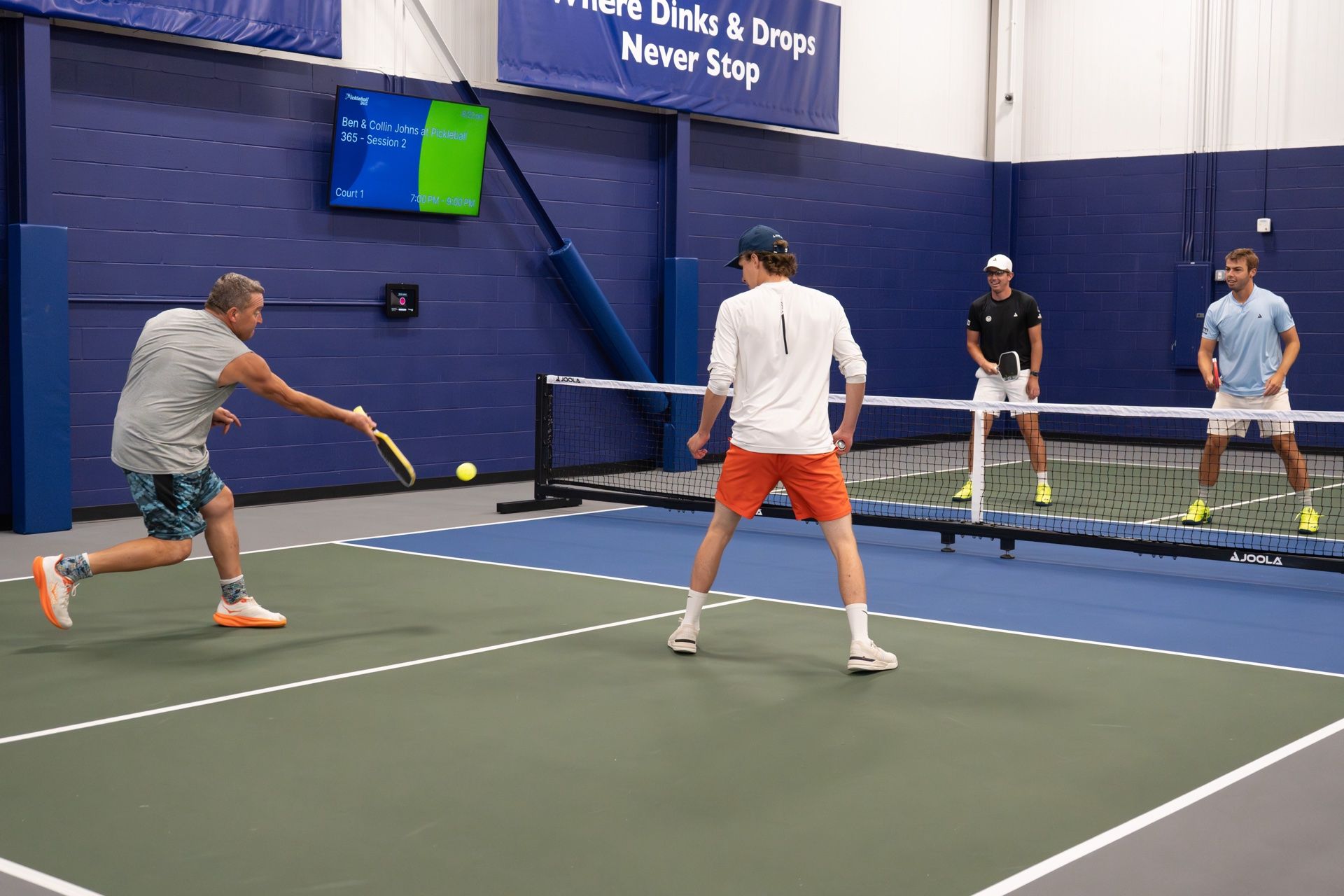
The JDC framework on autonomous-versus-staffed clubs is explicit: clubs of six courts or fewer are the autonomous sweet spot. Three courts unstaffed, in a community-tied location, with a JDC-designed build and a PodPlay technology stack, is precisely the formation JDC's autonomous-vs-staffed framework points at as optimal. Pickleball 365 isn't a one-off — it is the prototype for a category JDC has been mapping out.
The grand opening
When Pickleball 365 opened, Ben and Collin Johns were in Fair Haven for the grand opening. The presence of two of the most credible names in pickleball, at the opening of a three-court facility in a small Michigan exurb, said something about what this category of facility represents — and about the seriousness with which the design and partnership network treats the autonomous-three-court model.

The grand opening wasn't just a ribbon-cutting. It was a marker that the JDC-designed, PodPlay-powered, owner-operated autonomous club is the model that the people who set the standard in this sport are betting on for the next chapter of pickleball's growth.
If you are evaluating an autonomous pickleball facility, three questions sit on the table.
One: is the math real?
The Pickleball 365 results — 46% trailing-twelve-month utilization, 57% utilization in the most recent month, operating margins that exceed the benchmarks JDC publishes for successful scaled operations — are the answer. The Sharks Pool Club margin shift from 4% to 37% in a different vertical is the answer. The math is real and it has more than a year of Pickleball 365 operating data to back it.
Two: does it work for your market?
If your market is a small-to-mid-sized community with a pickleball-passionate population and a building you can lease at exurban rent rates — the kind of community Fair Haven represents, and the kind of community that exists by the hundreds across the country — the math points to three courts unstaffed. If your market is a denser suburban catchment that can support a larger build, the autonomous model still works at up to six-court footprints per JDC's framework, with a hybrid staffed/autonomous overlay viable at twelve courts and above. Different markets, different formations. The autonomous three-to-six-court model is a category, not a one-off.
Three: what does the operator path look like?
The Pickleball 365 path — start as a side project, build community, let utilization grow — is the path autonomous economics make available to owner-operators. It is a path that staffed economics do not allow for.
If the autonomous model fits your market, the build stack is straightforward: JDC for facility design and PodPlay for the technology platform. PodPlay's Autonomous tier covers the operating load — booking, payments, member management, league and tournament management, video replays, digital scoreboards, autonomous door access, and 24/7 remote monitoring — for a single line item that runs at a fraction of the labor it replaces. The Pickleball 365 success story is a proof point that something extraordinary is achievable on three courts in a small market.
To start a conversation about whether the autonomous model fits your facility plans, reach out to PodPlay at podplay.app. To start a conversation about facility design, reach out to JDC at jdcpickleball.com.
The math works. The category is opening. The next Pickleball 365 is somebody's side project right now.
More than 400,000 end customer accounts have moved to PodPlay from other club software as of October 2026. Here are the seven reasons clubs migrate, and the arithmetic behind the switch.
Oct 16, 2026
How one Las Vegas club owner sold court, wall and replay sponsorships to local businesses: what to sell, which verticals to call, and what to charge.
Oct 1, 2026
We only use cookies for necessary navigation of our website, performance tracking, or third party vendors. Our cookie tracking is used to better serve our users and users' interests.