
Single game AI ratings have arrived. The clubs that treat them as programming, not as a feature, are the ones that will create the most value for players and add to their bottom line.
In July, the number of AI-analyzed replays run at clubs on PodPlay more than doubled in a single month. We didn’t launch a campaign. Nothing got cheaper. Players just started asking the video what actually happened out there.
Then DUPR made it official. Starting this August, AI-powered video analysis feeds into DUPR ratings, with PB Vision — the analysis engine built into PodPlay — among the video partners whose output counts.
For a club operator, that sentence is worth reading twice. Something happening on your courts that went undocumented now produces a thing players want and will pay for: match data.
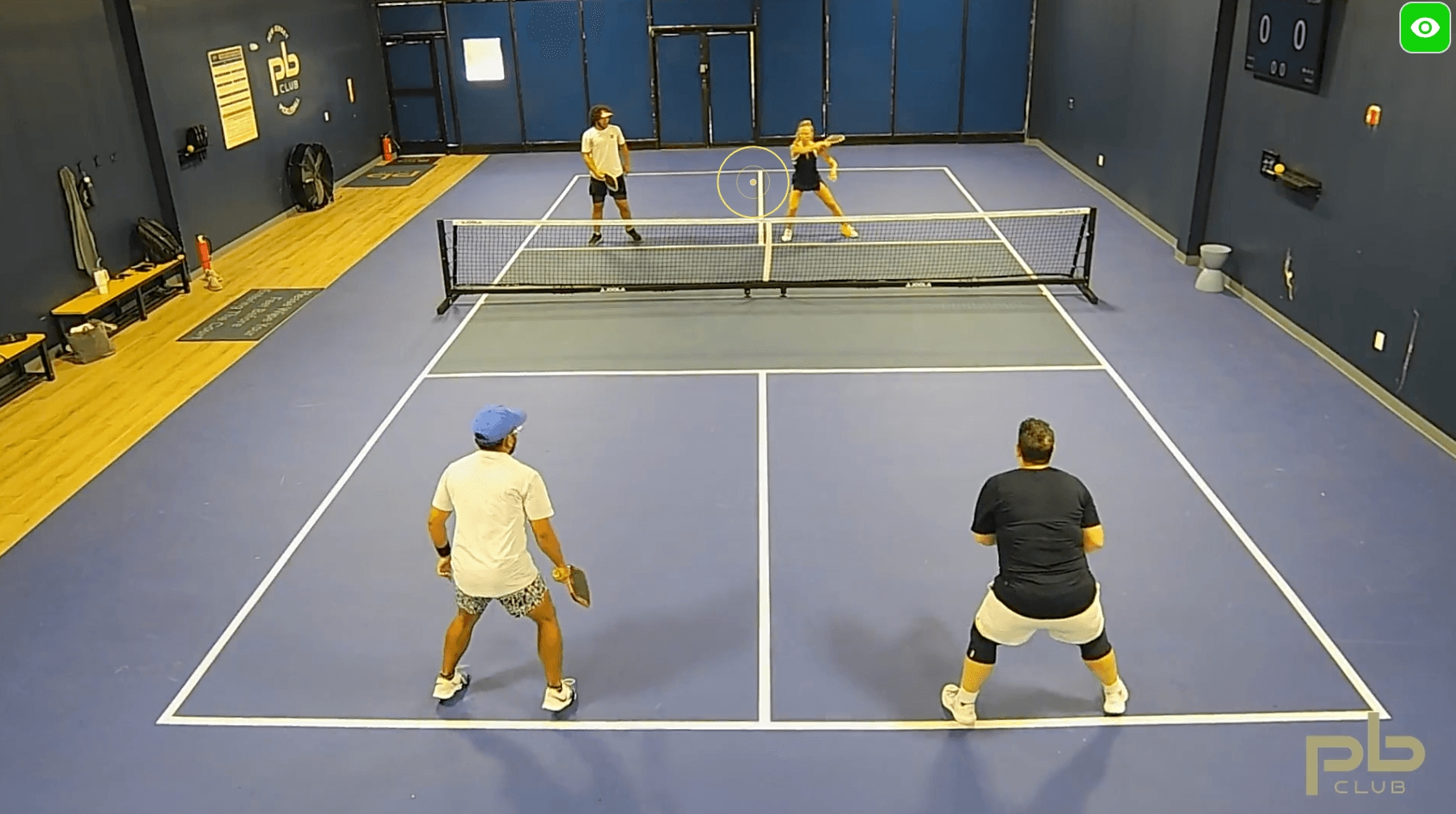
Strip out the mystique. A camera watches the match. A model tracks the ball and four bodies through every rally and writes down what happened: where the serve went, what the third shot did, how often each player got to the kitchen line, who won the exchanges once they got there, what happened on the backhand under pressure.
Out of that come two things. A shot-by-shot record of the match—a box score for pickleball, which the sport has never really had. And a rating derived from how a player actually performed, not from who happened to be standing next to them and across the net.
Baseball figured this out a century ago. You don’t evaluate a hitter off the final score. You look at the plate appearances. Pickleball has spent its entire boom with two data points per match: the score, and a rating that moves a little afterward.
Two things had to happen at once, and they finally did.
The models got good. Computer vision that can reliably track a plastic ball moving 40 miles an hour, distinguish four players, and tell a dink from a drop was a research problem a few years ago. The best models now produce output that holds up against what a good coach sees, at a cost that isn’t prohibitive.
The second thing is more recent, matters more to your operation, and gets talked about less: getting video in stopped being work.
The old workflow killed adoption before the analysis ever ran. Bring a tripod. Charge it. Frame the court and hope the angle was right. Play. Pull the card, download the file, find where the match started, trim the ends, upload, wait. That’s twenty minutes of chores for a rec match, and only your most dedicated members were doing that twice.
Most of that is now solved. Cameras live at the court, framed correctly and permanently. Where scoreboards are in use, the system detects on its own when a match starts and ends. There’s no file to find, nothing to trim, nothing to upload, and — critically for you — nothing for your front desk to administer.
Here’s the heuristic worth writing down: adoption of any analysis tool is inversely proportional to the work required to feed it. Until recently that work was high and the output was mediocre, so almost nobody bothered. Both curves crossed at roughly the same time. That’s the whole story of why this is a 2026 conversation and not a 2022 one.

We watched the crossover up close when PodPlay integrated PB Vision into our clubs in January. The analysis had been excellent for some time. The limiting factor was never accuracy — it was the twenty minutes of chores. Take those out, get it to three taps, and usage doesn’t tick up. It explodes. Hence July.
DUPR did something genuinely hard: it got a fragmented sport to agree on one number. Nothing here replaces that. A universal rating is what makes a stranger’s 3.9 mean something to your members.
But one number, by construction, flattens three things worth seeing—and each of those three is a program you can sell.
Cumulative versus today. A rating is a cumulative record of every game a player has played. It is not a read on the match they just finished. A member can play the best pickleball of their life on a Tuesday, watch the number barely move, and have no way to know it was the best pickleball of their life. Match-level analysis gives them the game log underneath the average.
Their play versus their partner’s. Doubles ratings are built on a team result, and a team result is a blunt instrument. Everyone has won matches they didn’t win and lost matches they didn’t lose. Shot-level data can say who actually generated the points—which is uncomfortable, occasionally humbling, and by far the most honest feedback in the sport.
The composite versus the components. A 4.0 rating doesn't tell you that your serve and return are above average and your consistency could use some improvement. Break your performance into buckets and you find out where you spike and what's dragging. That's the difference between knowing your level and knowing your next lesson.
The interesting development of the last several months isn’t just the advancement of the technology. It’s that operators have stopped treating analysis as a feature attached to court time and started treating it as an input to programming. Three formats have emerged, and they share a structure: the club builds an event around the data, prices it above the standard rate, covers the processing cost, and the player pays the event rate.
AI Rating Events. An open play (typically rotating doubles) where every game is recorded and submitted for analysis. Each attendee leaves with ratings across multiple games rather than a single data point. More players is better to increase the amount and variation of the data.
The obvious audience is the unrated player. Getting a first rating has historically meant either finding a rated group willing to absorb you or grinding out enough matches to stabilize a number. An AI Rating Event compresses that into an evening, inside a social format people already like. The less obvious benefit is that it’s a clean introduction to analytics for a segment of your membership that might never have opted into it on their own. They came for the number. They stay for the shot-by-shot.
For retention, this is the highest-leverage of the three. The unrated player is the one most likely to drift. Give them a number, a record, and a reason to come back and move it.
AI-Enhanced Coaching. A private lesson with a match at the front and a match at the back. The player plays, drills targeted skills, and the player plays again. The closing match is measured against the opening one. Coaches can provide feedback digitally using bookmarking and annotation tools.
This removes the two weakest moments in a private lesson: diagnosing from memory, and proving value at the end. The diagnosis now comes from the rally log. The proof comes from a before-and-after on the exact skill the lesson targeted. Pros teaching this way find it easier to sell the next lesson, because the player can see the thing that moved.
AI-Enhanced Clinics. The same structure in a group. Everyone plays matches at the outset. Coaching and drills focus on one or two skills—third-shot drops, kitchen-line exchanges, serve placements, etc. Everyone plays again at the end.
This solves a real problem with clinics, which is that they can feel like drilling with a side of socializing. Wrapping the instruction in live match play at both ends gives you the energy of open play with the targeted improvement of a lesson, and every participant leaves with individual evidence out of a group session.
On pricing. The pattern we see is consistent: clubs price these at a premium to the comparable standard event, absorb the processing cost as the club, and let the player pay the event rate. Members aren’t being asked to buy software. They’re buying a better version of something they already buy. That framing does most of the work.
One operational note. Every one of these formats has a structured-play component underneath it — rotating partners, court assignments, rounds, scores — and that's the part that eats the pro's evening. PodPlay Tournaments runs it natively: randomized play, rotating partners, challenge courts, timed rounds, with the next round generated the moment the scoreboard registers the match as over. No clipboard, no spreadsheet, no second app for anyone to download. The coach coaches. The system runs the rotation.
This is early. The models are good, not omniscient. The right posture is the one you’d take with any new statistic — useful signal, not gospel, and better every quarter. Operators who oversell it will hear about it from the first member who disagrees with their number.
But the direction is set. For the entire history of amateur pickleball, the only record of a match was the score and somebody’s memory, and memory is a generous narrator. That era is closing. Your courts are becoming a data source, and the data has a price.
The clubs figuring that out first are seeing cameras as not just video capture but a source of player data. They’re the ones building programming around the data the cameras produce.
Book a demo to learn more.
How one Las Vegas club owner sold court, wall and replay sponsorships to local businesses: what to sell, which verticals to call, and what to charge.
Oct 1, 2026
A case study of Premier Pickleball in Herriman, Utah, which became a magnet for local creators. The blog lays out a six-step playbook for building a creator strategy at your club.
Sep 23, 2026
We only use cookies for necessary navigation of our website, performance tracking, or third party vendors. Our cookie tracking is used to better serve our users and users' interests.