
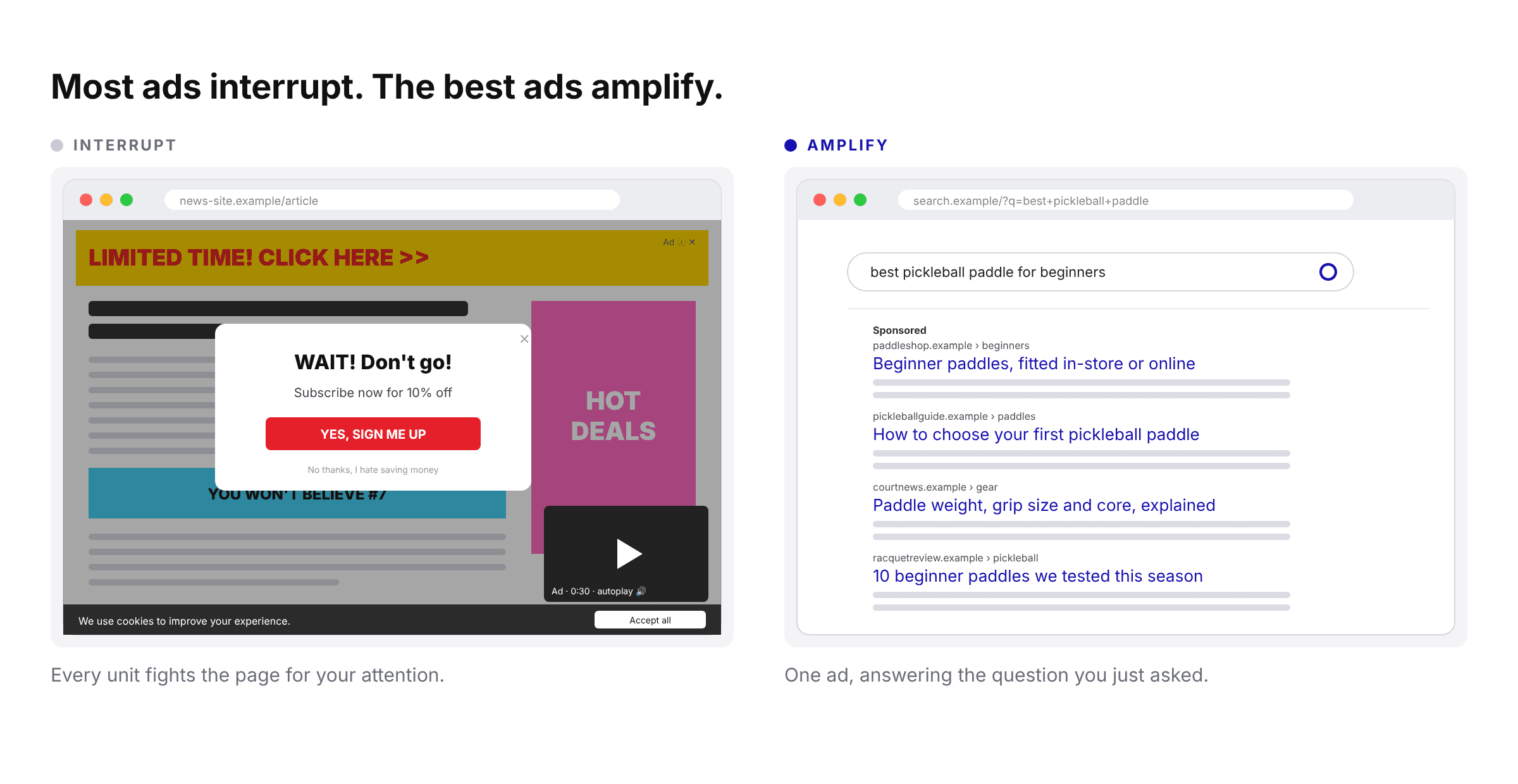
Most ads interrupt. The best ads amplify.
That was the core idea of Billboards, But Better, which I wrote in August 2025.
 At the time it was a thesis with one great data point behind it: a single Best of Pickleball reel with Kaitlyn Kerr had passed 285,000 views, and we worked out what a sponsor would have paid to be in it.
Fifteen months later the thesis is backed by far more data. When that post went up, PodPlay had served about 875,000 replays since launch. We have now served more than 2.3 million. The number of courts serving replays on a PodPlay screen each month has gone from about 340 to more than 830.
So it is worth revisiting the argument with better evidence and a sharper claim. The most valuable advertising surfaces in history were built for something else. The ads came later, and they were worth more because of it.
Every premium ad surface I can think of has the same three ingredients.
Google is the cleanest example. Search was built to answer questions. Ads arrived later and rode the intent people already brought to the search box. Google wrote its restraint into its own philosophy: ads only where they are relevant, always labeled, and no pop-ups, because, in its words, “advertising can be effective without being flashy.” That restraint built the most valuable ad business ever made.
Instagram is the second. When Facebook bought it in 2012 for about $1 billion, it had practically no revenue. The first ad ran on November 1, 2013: a Michael Kors watch on a café table next to a plate of macarons, posted like any other photo and marked “Sponsored.” It came from a short list of brands Instagram had lined up because they already knew how to make something people would want in their feed. The ad looked like the product, and that was the point.
Then the Masters. Augusta National limits the broadcast to four minutes of commercials per hour, roughly a fifth of a standard sports broadcast, split among a handful of partners. Scarcity is the product. Every sponsor in that broadcast buys attention it never had to fight for, sitting next to something people love.
Three different media. One recipe.
The opposite recipe is everywhere, and it is easy to spot.
The first banner ad ran on HotWired in October 1994. It was for AT&T, and 44% of the people who saw it clicked. Today a standard display banner gets clicked somewhere around a tenth of a percent of the time, and plenty of those clicks are accidents. Nothing about the banner got worse. Everything around it did: more of them, louder, stacked down every page until readers learned to look straight past the edges of the screen.
Ethan Zuckerman, who wrote the code for the first pop-up ad at Tripod in the 1990s, later apologized for it in an Atlantic essay titled “The Internet’s Original Sin.”
The pattern repeats. When a surface exists to carry ads, people learn to tune it out. The owner adds more ads to make up the revenue, which teaches people to tune out faster. Inventory goes up. Value goes down. Every banner-choked website you have ever closed started as a site somebody liked reading.
Screens follow the same law. A screen that rotates ads at whoever happens to walk past is a banner on a wall.
Billboards, But Better measured ad media against four things an advertiser wants: reach, targeting, engagement and association. It identified two placements for PodPlay replays: the Instant Replay on the in-club screen, and the Digital Replay that lands on the player’s phone.
With fifteen months of data, those two placements are better described as two kinds of inventory that brands and agencies already know how to buy:
Most media owners have one or the other. A gym network has screens. A creator has a feed. PodPlay has both, and both fire from the same moment: a player hits a great shot and presses the button.
That shared trigger is the whole argument. The sponsor shows up once on the wall, and again everywhere the moment goes.
Start with DOOH, because it is where scale is easiest to verify.
 Both curves compound. The number of courts serving replays on a PodPlay screen each month doubled over the past year, from 417 in October 2025 to 838 in October 2026. Replay volume compounds on top of that: PodPlay served about 1.3 million replays in the last twelve months, more than in every prior year combined.
What separates this inventory from a TV bolted to a gym wall is what plays on it. The screen at the net carries three sponsor assets, and each one sits beside a moment players already care about.
The scoreboard logo. The screen at the net is the court’s live scoreboard, and it is wired into the rest of the club. During a tournament match, a league night or a structured open play session, it knows who is playing, which round it is and what is at stake, because the same system built the bracket, set the schedule and booked the court. Players look at it after every point. The score and the game hold the center of the screen, and the sponsor’s logo sits in a slim band along the bottom: quiet, tasteful, and in view every time someone checks the score. A billboard waits for someone to glance up. This screen is part of the game.
The replay pre-roll. The most-watched content in a racquet sports club is a player’s own last point. When a player presses the button, the whole court turns to the screen, and a short sponsor bumper leads into the replay. It plays like a broadcast transition: a beat of build-up before the payoff, over before anyone could wish it away. It lands at the moment of maximum dopamine: the point just ended, the group is still buzzing, and every eye on the court is on the screen. Nobody walks past a replay of themselves.
 Playlist ads. Between matches and replays, the screen runs curated playlists: highlights from PodPlay clubs, pro tour content and coaching tips, with sponsor spots layered in. The playlist comes first. The ads are a share of it. Because the playlist runs on the same system as the court schedule, it also knows what kind of session is on. A sponsored tournament, a private event and an open play session can run back to back on the same court, and each gets its own treatment: the tournament sponsor during the tournament, the host’s own content at the private event, the club’s promotions during open play.
The second surface starts where the first one ends.
Every replay is tied to a booking and a player, so it is already in the player’s app when they walk off court. No QR code, no new account. From there it goes where people go: the group chat, Instagram, the club’s own feed.
At scale, that is a media business. PodPlay replay content has passed 39.7 million views across Instagram, YouTube and LinkedIn from 669 trackable posts. And it is accelerating: 88% of those views came from posts published in the last twelve months. It runs through our own channels and through partners with their own audiences: ClipTHAT with The Dink, the Monthly Top 10 Amateur Highlights with The Kitchen, Highlight and Blooper of the Week with DUPR and Pickleball.com, and Best of Pickleball with Kaitlyn Kerr.
 And every one of those numbers counts only what we can track. Clubs post replays to their own accounts. Players send them to group chats and share them to their own feeds. None of that shows up in our totals, and every one of those shares carries the clip, and the sponsor on it, to an audience we never counted. For a sponsor, that long tail is all upside.
The replays are getting richer, too. Through our integration with PB Vision, any replay on a PodPlay court can become an Enhanced Replay: AI video analysis with a shot-by-shot record of the match, with nothing for the player to upload or trim. Enhanced Replays at PodPlay clubs more than doubled in a single month this summer, after DUPR began counting AI video analysis toward ratings. Players use it to see what actually happened out there, and coaches use it as evidence for the next lesson. Either way, it gives a player one more reason to open the replay, keep it and send it.
Out-of-home advertising has discovered racquet sports clubs: rooms full of engaged players who stay for an hour or more at a time. Operators are going to be offered a lot of screens. There are two ways to build that network, and they start from opposite ends.
Network-first starts from the ad slot. The goal is the most impressions on the most screens. The network often funds the hardware, which is a real benefit to an operator watching capex. In exchange, the network decides what plays: loops rotate fast, programmatic demand fills the gaps, and the screen runs ads whether anyone is on court or not. It puts screens on walls quickly. The risk is that players learn the screen is something to ignore.
Experience-first starts from the player. The screen’s first job is the game: the score, the replay, something worth watching between points. Sponsors get a defined share of the loop, set by the club, next to attention the screen has already earned. Fewer ad slots, each worth more.
 We chose experience-first, for the same reason Google kept pop-ups off its results page. The value of every slot depends on players still wanting to look at the screen a year from now. Inventory you degrade to fill is inventory you will struggle to sell.
That is taste applied to media. In Taste as a Moat in the Age of AI I argued that when anyone can build, the judgment about what to leave out carries the value. Ad networks work the same way. Anyone can sell a slot. Few have the discipline to protect what makes the slot worth buying.
Your screens are part of your member experience. Before you hand them to anyone, ask five questions:
On PodPlay, the club holds the answer to all five. You control the playlist and the ad share, and the sponsors you sell stay yours. The screens are the same ones that run your scoreboards and replays, so what makes them valuable to a sponsor is what your players already use every day.
Three things set this inventory apart from anything else you can buy in the sport:
That is also why we don’t sell this inventory by the thousand. Pricing per impression treats every impression as interchangeable, and interchangeable inventory competes on price alone. The Masters understands this: its handful of partners buy a presence in the broadcast, outside the ratings guarantees that govern the rest of sports TV. PodPlay sponsorships work the same way. A brand buys the bundle (the screen at the net, the replay in the player’s pocket, and the clips that travel through our media partners) as one partnership, packaged by category.
Premium Inventory = Engagement × Taste × Reach.
It is multiplication on purpose. Push reach toward infinity with zero taste and the product goes to zero, which is the history of the banner ad in one line. Build a beautiful surface nobody sees and you get the same answer.
Build the surface people love. The sponsors will find it.
PodPlay is the all-in-one platform for modern racquet sports venues: club and tournament management software, video capture and court-side screens, and autonomous capabilities in one integrated system. Built and field-tested inside PingPod’s autonomous clubs, PodPlay now powers 300+ clubs and 2 million players across pickleball, padel, tennis, ping pong, golf and more.
Operators: request a demo. Brands: talk to us about sponsoring PodPlay screens and replays.
Up to 64 teams, one point per match, $5,000 to the winners. How the Paddletek One Point Slam at CityPickle worked, and why programming that tells a story wins.
Oct 26, 2026
More than 400,000 end customer accounts have moved to PodPlay from other club software as of October 2026. Here are the seven reasons clubs migrate, and the arithmetic behind the switch.
Oct 16, 2026
We only use cookies for necessary navigation of our website, performance tracking, or third party vendors. Our cookie tracking is used to better serve our users and users' interests.